




Vector Graphics Logo for Printing: Why It's Indispensable for Promotional Gifts?
Imagine opening a long-awaited delivery of new, representative company fleeces, only to find your company's symbol on the fabric is blurry, jagged, and unprofessional. This is every marketing manager's genuine nightmare, needlessly wasting both valuable time and the company's marketing budget. Most printing problems and subsequent disappointments stem from the wrong file format, which is why a vector graphics logo for printing is the only sure choice if you want to achieve an impeccable and sharp result on every product. Even a seemingly clear JPG file can completely lose its quality when enlarged or applied to different materials, leaving a sloppy impression of your brand.
We agree that navigating the maze of file extensions like AI, EPS, and PDF versus a standard image file can initially seem a complex and confusing task. In this article, you will discover exactly why vector graphics are the unwavering cornerstone of quality printing and how to ensure your logo is perfectly presented on every chosen promotional gift. We will look closer at how to avoid pixelated failures, save time searching for the right file, and make collaboration with your gifts partner as smooth as possible. Your brand deserves a presentation that reflects your professionalism and dedication in every minute detail.
Key Points
- You will learn why a vector graphics logo for printing is the only way to avoid blurry results and ensure unlimited scalability of your logo on any promotional gift.
- You will learn to distinguish the correct file formats (AI, EPS, PDF) and understand their critical role in various printing technologies.
- You will discover a practical checklist to ensure that fonts and lines are correctly prepared for production.
- You will understand how professional logo vectorisation helps prevent defects and significantly saves your time and marketing budget.
- You will gain an overview of how Logotrade's expert knowledge ensures your brand's impeccable presentation even on the most demanding materials.
WHAT ARE VECTOR GRAPHICS AND WHY ARE THEY NEEDED FOR PRINTING?
When planning to order your first branded souvenirs, you will immediately encounter a technical requirement: the logo must be in vector format. Many marketers initially send a PNG file saved from their website, hoping for the best. However, this is a sure path to a low-quality result. Your brand's visual identity deserves more than blurry edges and sloppy printing. This is where a vector graphics logo for printing comes into play, forming the foundation of a professional promotional gift.
A more detailed explanation on What are vector graphics? confirms that it is line graphics based on mathematical formulas and coordinates. Unlike a standard photograph, which consists of a limited number of coloured points or pixels, a vector describes the relationships and curves between points. This means the file does not contain the image itself, but rather instructions for drawing it. This approach ensures clean and sharp lines, which are critically important in the printing process.
Vector Graphics vs Raster Graphics: A Simple Comparison
Imagine your logo on a ballpoint pen and then on a gigantic exhibition banner. With raster graphics (like JPG or PNG), enlarging means "stretching" the pixels. The result is jagged edges, known as pixelation. This problem does not occur with a vector file. Since the image is recalculated each time according to the required size, the result is always perfect. Your website logo is optimised for fast loading and small screens, not for application to a physical product. Using vector graphics saves your marketing budget because one correctly prepared file will serve you for years and is suitable for every possible souvenir without additional rework costs.
Why Do Printers Require a Vector File?
Printing machine software is designed to read line coordinates, not interpret pixel masses. This is particularly important for technologies where the logo is not simply printed onto a surface, but must be cut out or embossed from the material. Logotrade has curated thousands of orders for over 21 years, and we know that without a vector, it is impossible to create precise clichés or cutting lines. Additionally, a vector file allows for the specification of exact Pantone colour codes. This is the only way to ensure that your brand's symbolism looks exactly the same on paper, metal, and textile. If you lack a suitable file, Logotrade offers professional design services to transform your vision into print-ready reality.
THE ROLE OF VECTOR FILES IN VARIOUS PRINTING TECHNOLOGIES
The final quality of a promotional gift depends not only on the chosen product but also on how precisely your symbolism can be applied to it. This is where a vector graphics logo for printing plays the leading role. Each printing technology places its own specific demands on the file, which a standard image file simply cannot meet. Throughout its 21-year history, Logotrade has repeatedly experienced how a poor-quality source file can spoil even the most luxurious corporate gift. Our experts' task is to ensure that the logo is adapted according to the material of the specific item, whether it be soft textile or hard metal.
Pad Printing and Screen Printing
Pad printing and screen printing are classic methods where colour is applied to the product through a physical cliché or mesh. A vector file is indispensable here because it allows the designer to separate colours layer by layer. This is a critical step if you want to print a multi-coloured logo. Clean and sharp outlines in the vector file ensure that the colour does not bleed over the edges, and the result remains correct even on the smallest surfaces. This is precisely why a vector logo in printing technology is the first preference for professional printers and designers. It is especially important for tiny souvenirs, such as ballpoint pens, where logo details may only be a few millimetres in size but must still remain legible.
Engraving and Embroidery
For engraving and embroidery, it is impossible to start work with a pixel-based image. The laser beam follows precise mathematical coordinates and lines during engraving. If there are no vectors in the file, the machine simply does not know which path to follow. Similarly, the creation of every high-quality embroidery programme always begins with clean vector graphics, which are "translated" into stitches understandable by the machine. One of the most critical stages here is the curving of texts, or changing fonts into lines. This eliminates the risk that the printing machine's software will replace your unique brand font with some arbitrary typeface.
Logotrade's experienced specialists thoroughly check every file before sending it to production to prevent errors and ensure the best result. Our goal is to make your brand visible and memorable. If you are unsure whether your current file is print-ready, it is worth exploring our wide selection of promotional gifts and consulting with our team. We will help you find the best solution that precisely meets your company's needs and chosen printing technology.
COMMON VECTOR FILE FORMATS: AI, EPS, PDF AND SVG
The world of file extensions can initially seem a technical maze, but choosing the correct format determines the fate of your promotional gift. The most common and preferred is AI, the native Adobe Illustrator file. This is the industry standard, preserving all logo layers and details in an editable form. As Adobe is the true creator of this technology, they offer the best explanation on What are vector graphics? and their infinite scalability. An AI file is like the master file of a logo, from which all other necessary versions can be created.
Another frequent guest is EPS, which functions as a universal format. It is particularly valued in communication between older printing machines and various software platforms. The most insidious, however, is PDF. Although the PDF format supports vectors, it can simply be a container holding a standard image. If you save a low-quality JPG image as a PDF, it will not magically become print-ready. A vector graphics logo for printing must be originally created in vector form within the PDF. SVG is a modern solution primarily encountered on the web, but thanks to its mathematical structure, it is also perfectly suitable for printing.
How to Recognise the Correct File?
The main mistake often made is manually changing the file extension. Renaming the end of a file from .jpg to .pdf does not change the image's content or quality. One sure sign of a print-ready file is that all texts are curved, or outlined. This means that the letters have been converted into lines, and the print shop does not require your specific font to display the logo correctly. If you order a logo from an agency, always ask them to send a vector file where the texts have been converted into lines. This will save you time and unexpected additional charges later on.
What to Do If You Only Have an Image File?
If you only possess a pixel-based image file, the only solution is vectorisation. This means redrawing the logo manually using vector graphics software. Many clients rely on automatic trace functions in programmes, but this often fails; edges remain uneven and fine details are lost. The Logotrade team has been helping clients make logos print-ready for over 16 years. Our professional design services ensure that you receive a perfect file that will serve your company for years. We do not just change the file; we check every detail to ensure the result on the promotional gift is impeccable.
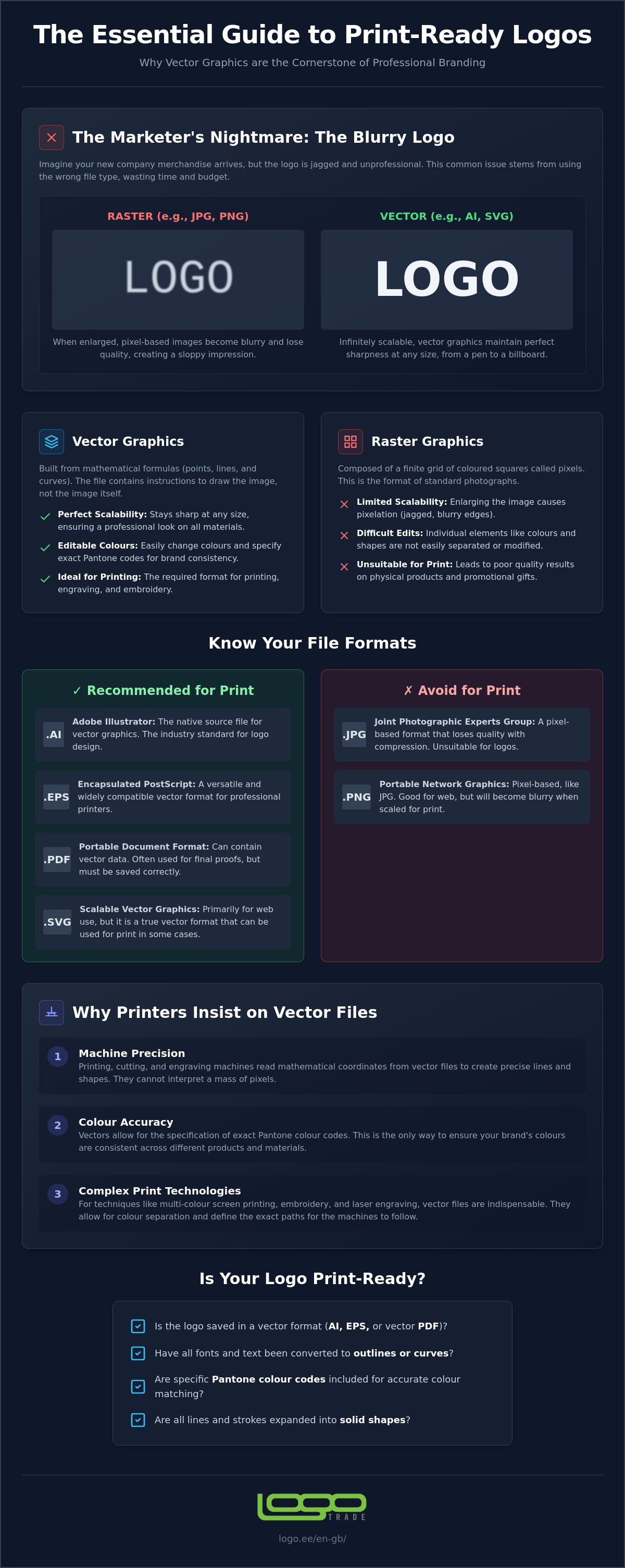
CHECKLIST: IS YOUR LOGO PRINT-READY IN 2026?
Before confirming your next promotional gifts order, it is worth taking a moment to check the technical condition of the source file. A correctly prepared vector graphics logo for printing will save you from unexpected additional costs and production delays. Printing standards for 2026 have become increasingly precise, meaning a generic file is no longer sufficient. The visual purity of your brand depends on details that are not always noticeable to the naked eye on screen.
- File Type Confirmation: Ensure the file is saved in AI, EPS, or vector-PDF format. If you enlarge the PDF file by 600 per cent, the edges must remain perfectly smooth.
- Text Status: All lettering on the logo must be converted to lines (curves/outlines). This is a critical step that prevents fonts from being replaced at the print shop.
- Colour Model Check: The file must be in CMYK colour space. If your brand has specific Pantone codes, these must be correctly defined in the file.
- Minimum Size: Check whether the logo details and texts are legible even when the logo's dimensions are, for example, just 5 millimetres on a ballpoint pen.
- Version Availability: A professional logo package always includes horizontal and vertical layouts, as well as separate versions for light and dark backgrounds.
Curving Texts – Why Is It Necessary?
Imagine a situation where your logo, with its unique typeface, is replaced in print by a standard Arial font. This happens when the print shop's computer lacks your company's specific font and the file has been left as editable text. The 'Create outlines' command in Illustrator converts the text into a mathematical shape. After this, the font is no longer needed to open the file, as the software reads the letters as ordinary lines. This simple action saves your order and ensures that the brand's identity is preserved exactly as the designer originally intended.
Colour Management and Brand Purity
RGB colours are designed for screens with emitted light, but printing uses the CMYK system, where colours are created by mixing four primary colours on paper or a product. This is why a logo that appears vibrant blue on screen might look duller in print. The Pantone system acts as an international language here; it is a standard that guarantees your brand's colour is consistent in Estonia and elsewhere in the world. Logotrade experts will help you choose the correct colour solutions according to the product material, whether it is porous textile or glossy metal. If you want to be sure of your logo's impeccable presentation, explore Logotrade's portfolio of completed works to see real examples of quality execution.
LOGOTRADE DESIGN SERVICES: PERFECT RESULTS ON EVERY GIFT
Logotrade has been providing branded corporate gifts and professional solutions in Tallinn and across Estonia for over 21 years. Our extensive experience means we have seen all kinds of files and solved even the most complex printing challenges. We are not just intermediaries; we are your partners, ensuring that your brand's symbolism looks exactly as representative as it was originally planned on paper or screen. Our experts know precisely how a vector graphics logo for printing must be prepared to avoid defects and ensure customer satisfaction with every order.
One of our design team's most important tasks is a thorough technical check of every incoming file. We never send an order to production if the file quality does not meet our strict requirements. If your logo is outdated or you only have a blurry image file, then Logotrade's vectorisation service is for you. Our designers will manually redraw your old JPG file into a new, clean vector image. This is a long-term investment, as a correctly created file will later be suitable for everything: from ballpoint pens to large outdoor advertisements. We are a member of the Estonian Chamber of Commerce and Industry and value quality at every stage of work, offering expert design services to every client.
Why Trust Your Logo to Us?
Our working principle is simple: we never print a poor-quality file without first warning the client. If we see that a submitted file might appear unclear in print, we will contact you immediately and offer solutions. We provide a complete solution, helping you choose the right gift and matching it with the best printing method. Different materials react differently to colour; what suits metal may not always work on textile. We are specialists in ensuring optimal logo visibility and recommend technology that highlights your brand's strengths. Explore the results of our long-standing work and be inspired by our portfolio of completed projects.
How to Start Collaboration?
Starting collaboration with Logotrade has been made as convenient as possible for you. You do not need to worry about technical details; simply send us your logo and describe your product requirements. Our experts will review the file and provide immediate feedback. We offer personalised consultation in Tallinn and across Estonia to find strategic promotional gifts that meet your company's needs. Utilise our expertise to transform your marketing gifts into genuine tools that enhance brand awareness and trustworthiness. Choose suitable promotional gifts here and send us your logo so we can create something outstanding together!
YOUR BRAND'S VISUAL QUALITY IS AN INVESTMENT IN THE FUTURE
Your company's symbolism deserves a presentation that reflects your professionalism in every minute detail. We have made it clear that a correct vector graphics logo for printing is the only sure way to guarantee a sharp and clean result, regardless of the chosen material or printing technology. This technical preparation eliminates blurry edges and font errors, whilst saving your valuable marketing budget and time in the long run.
Logotrade has been a reliable partner to thousands of clients for over 21 years, ensuring impeccable print quality on every product. As a member of the Estonian Chamber of Commerce and Industry, we offer security and professional design control for every order, so that no poor-quality file reaches production. Our experts are ready to advise and assist you with logo vectorisation, ensuring your brand's message is delivered exactly as you intended. Your logo is your business card in the recipient's hand, so let us ensure together that it always leaves a memorable and perfect impression.
VIEW OUR SELECTION OF PROMOTIONAL GIFTS AND ORDER PRINTING
Start your next campaign with confidence, knowing that your symbolism is in the best hands.
Frequently Asked Questions About Vector Graphics
What are vector graphics and why are they better for printing than a standard image?
Vector graphics are based on mathematical points and line coordinates, not coloured pixels like a standard photograph. They are better for printing because a vector file can be enlarged indefinitely without any loss of image quality or sharpness. A standard image becomes blurry and jagged when enlarged, but a vector always maintains clean outlines. This is particularly important for promotional gifts, where the logo size can vary from a ballpoint pen to a banner.
Can I convert my JPG logo to a vector file myself?
Simply renaming the file extension from .jpg to .pdf or .ai will not magically convert the image to a vector format. High-quality vectorisation requires redrawing the logo using specialised software, such as Adobe Illustrator. Automatic programmes often make mistakes and leave edges uneven, which is why we recommend using a professional design service. Logotrade's designers will do this work for you, ensuring that every line of the logo is precise and print-ready.
Why does the print shop say my PDF file is not in vector format?
PDF is a container file that can hold both vector graphics and a standard raster image. If you have saved a low-quality image into PDF format, it will still remain a pixel-based image that cannot be enlarged without loss of quality. Print shops require a file where the logo elements are created as lines and curves. Our team always checks the content of submitted PDFs to prevent unexpected problems in the printing process and ensure your brand's impeccable presentation.
What does 'curving' texts or creating 'outlines' mean?
Curving texts means converting typefaces or fonts into mathematical lines and shapes. This is necessary because if the print shop's computer lacks your company's specific font, the software will automatically replace it with an arbitrary typeface. Once texts are converted into lines, the font is no longer needed to open the file, and the logo will display correctly on any device. This simple step ensures the preservation of your brand's visual identity and eliminates typical printing errors.
Can vector graphics also be used on a website?
Yes, vector graphics are increasingly popular on the web and are primarily used in SVG format. SVG files are very space-efficient and remain sharp at any screen resolution, whether it is a smartphone or a large monitor. Although PNG files are often found on websites, a vector solution is more future-proof and faster. However, it is worth remembering that files optimised for the web often require additional colour management for printing to ensure the result precisely matches your brand's standards.
How much does logo vectorisation cost at Logotrade?
The cost of logo vectorisation depends on the complexity of the specific symbolism and the number of details. As each project is unique, we provide a personalised quote based on the condition of your source file and the scope of work. A professional vector graphics logo for printing is a one-off investment that quickly pays for itself, as it saves you from future file rework costs. For more detailed information, please contact our client managers, who will help you find the most suitable and cost-effective solution for your needs.
What are the most common mistakes clients make when sending logo files?
The most frequent mistake is manually changing the file extension without actually vectorising the content. Clients often send small files saved from a website or logos where texts have been left uncurved. Another common problem is using the RGB colour space instead of CMYK, which can unexpectedly dull the logo's colours in print. Logotrade's 16 years of experience help prevent these errors, as our designers critically review every file before production.
Do I need different vector file versions for light and dark products?
Yes, a high-quality logo package should include versions for both light and dark backgrounds. On a dark product, a dark logo may become invisible, necessitating the use of a light or white version. It is also important to have a single-colour, or monochrome, variant for technologies such as engraving or embossing. Our experts will always advise you on which version to use for a specific promotional gift to achieve maximum visibility and the best aesthetic result in every situation.